


(WHAT YOU DON’T KNOW, YOU DON’T KNOW)
Now that you’ve sampled a taste of what campaigning for a board position might be like (see the April edition of the Breeze), it’s time for you to get down to the actual governing as a member of the board of directors. Here’s where your homework starts to pay off. No one is an expert on all the various topics that come before the board, but it’s the variety of backgrounds and history of experiences of each board member that can be brought to bear when faced with the unknown. While it would seem to make sense to require potential board members to have some background to effectively deal with these governing topics, neither Chapter 720 of the Florida Statutes nor our governing documents permit such restrictions on homeowners who wish to pursue candidacy as potential board members.
What is required by Florida statute is a prescribed four-hour or eight-hour course of instruction, the length of which is based upon the number of units in an association. The four-hour course must be taken by those directors whose association is less than 2,500 units. For associations with 2,500 or more units, new directors are required to take the eight-hour course. In either case, the course must be completed within 90 days of election or appointment to the board. Although these courses are available without charge, the completion certificate earned by those attending this course must be held within the association’s records for a minimum of five years. There is no requirement that you be a board member to sit through the presentation, which is normally conducted by a law firm versed in community association law.
As you may imagine, while the items covered are quite varied, it is reasonable to recognize that the course is really a summary or survey of the many topics that can be taught in a four-hour or eight-hour course of instruction. Examples of the types of subject matter presented are the governing documents themselves and what types of information are to be found in each of them. Records storage requirements, both personnel as well as financial records, including contracts, legal filings, and demographic data for communities designated as 55-plus are also covered. Should you be interested in how to find these statutes, here is the website for all of Florida’s statutes as of the 2025 legislative session: https://www.leg.state.fl.us
• Title XXXVI is about BUSINESS ORGANIZATIONS in Chapters 605-623
• Chapter 617 is about Corporations Not for Profit
• Title XL is about REAL AND PERSONAL PROPERTY in Chapters 689-723
• Chapter 712 has to do with Marketable Record Titles to Real Property
More than five years ago, the legislature took steps to help associations preserve their existence by requiring that the first board meeting following the annual member meeting (when elections normally take place) to have the Marketable Record Titles Act (MRTA) on the agenda. This requirement is designed to assure that associations do not exceed the 30-year deadline. This is to preserve the marketable record of each association and thereby prevent the extinguishment of the legal standing of any association.
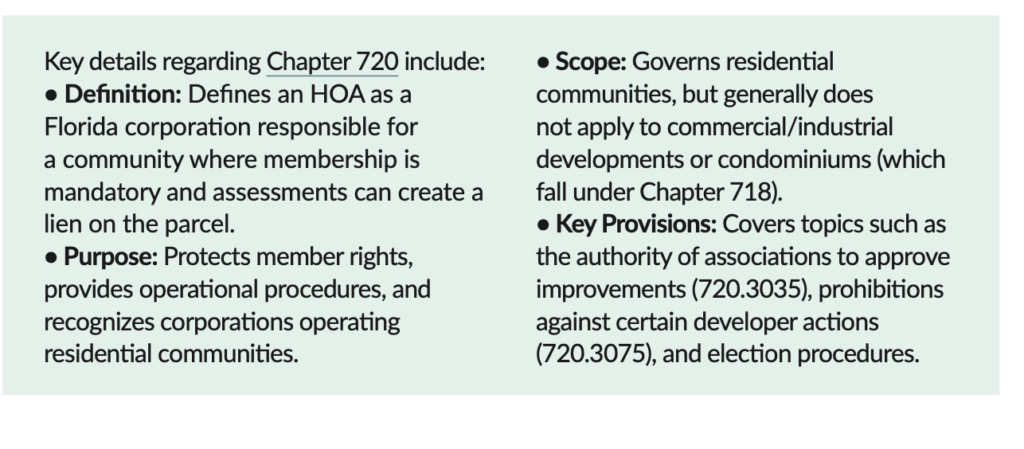
Chapter 720 is specific to Homeowners Associations.
The Articles of Incorporation are exactly what is sounds like, in that this document is essentially historical where the establishment of the association is drawn up in compliance with the applicable statute, namely, Chapter 617. The Articles of Incorporation establishes the foundation, which grants the association the authority to operate for the benefit of the members (homeowners). The association’s primary responsibility is to preserve the assets of the corporation using the authority granted to it from the state. The is the key to the fiduciary responsibility that every board member must carry by using sound financial judgment. Sabal Springs is very similar in many ways to a small town or village. This is the concept that results in the community spirit and sense of belonging that fosters a friendly, welcoming neighborhood so many transplants are looking for.
The Covenants and Restrictions specifically describe the “nuts and bolts” of what our association actually is. It begins with a definition of the terms used within the Covenants and Restrictions. It then itemizes the parts of the association and how they work together to enable the association to achieve its purpose.
The By-Laws further refine how the governance of the association is conducted, in concert with the Covenants and Restrictions. In them, you’ll find what constitutes a quorum, what is the yardstick for the adoption of changes or amendments, how many consecutive terms are permissible by a director, how meetings are conducted along many other similar items. It is here that you will learn that while the membership votes to elect members of the board, it is the board itself that votes upon which director will hold what office, not the membership.
The Rules and Regulations provide the flexibility to further define and finetune very specific areas of concern to assist association members and the board of directors to comply with the intent of the Covenants and Restrictions.
Changes to our Covenants and Restrictions or our By-Laws require a two-thirds (2/3) majority of the members voting in order for the changes to pass. On the other hand, the Rules and Regulations can be altered at any time by a majority of the board of directors.